
USN
596,271 members•32,193 units
Opening branch overview
Building the branch home surface
Loading branch highlights, featured unit context, and gallery moments.
Overview
Members
Units
596,271 members•32,193 units
Building the branch home surface
Loading branch highlights, featured unit context, and gallery moments.
Building the branch units surface
Loading unit filters, rankings, and the branch unit grid.
VP-91
U.S. Navy
HC-2 FLEET ANGELS
U.S. Navy
Helicopter Combat Support Squadron TWO (HC-2), known as the "Fleet Angels," was established in 1948, making it one of the U.S. Navy’s oldest dedicated helicopter squadrons. Originally formed as a utility squadron, HC-2 provided vital search and rescue (SAR), logistics, and vertical replenishment support to the Atlantic Fleet. Over the decades, the Fleet Angels participated in numerous high-profile operations, including disaster relief missions and combat support during conflicts such as the Vietnam War and Operation Desert Storm. The squadron was decommissioned in 2006, but its legacy endures as a pioneer in naval helicopter operations and SAR excellence.
NAVAL SUBMARINE SCHOOL
U.S. Navy
USNH GUAM
U.S. Navy
USS ARLINGTON
U.S. Navy
USS BRONSTEIN
U.S. Navy
USS COMPASS ISLAND
U.S. Navy
USS Hector (AR-7)
U.S. Navy
USS Hector (AR-7) was a repair ship of the United States Navy commissioned in February 1944. Serving throughout World War II, Hector provided vital repair and maintenance services to the Pacific Fleet, supporting operations in the Marshall Islands, Marianas, and the Philippines. After the war, she continued her service during the Korean and Vietnam Wars, often operating in forward areas to keep U.S. naval forces operational. Decommissioned in 1987, USS Hector earned numerous battle stars for her decades of dedicated support to American naval operations.

USS HORNET
U.S. Navy
USS Hornet is the name carried by several distinguished ships in U.S. Navy history, most famously the aircraft carrier CV-8. Commissioned in 1941, USS Hornet (CV-8) played a pivotal role in World War II, notably launching the Doolittle Raid on Tokyo in April 1942, the first air raid to strike the Japanese home islands. The carrier also participated in the pivotal Battle of Midway, contributing to the turning of the tide in the Pacific Theater. Despite her heroic service, CV-8 was sunk during the Battle of the Santa Cruz Islands in October 1942, but her legacy endures through subsequent ships bearing the Hornet name, including CV-12, which served in World War II and later as a recovery ship for Apollo missions.
USS KAWISHIWI
U.S. Navy
USS MILWAUKEE
U.S. Navy
USS POINT LOMA
U.S. Navy
USS SAN FRANCISCO
U.S. Navy
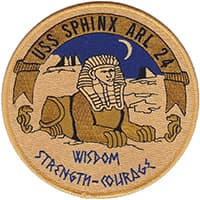
USS Sphinx
U.S. Navy
USS Sphinx (ARL-24) was a landing craft repair ship of the United States Navy, originally commissioned in 1945 near the end of World War II. Built as LST-963 and later converted to an Achelous-class repair ship, she provided crucial repair and maintenance services to amphibious forces in the Pacific. Reactivated for the Vietnam War, USS Sphinx supported riverine and coastal operations, earning multiple campaign stars for her service. Decommissioned in 1971, she continued to serve in civilian roles before being struck from the Naval Vessel Register.
USS SUNBIRD
U.S. Navy
USS Worden (CG-18)
U.S. Navy
USS Worden (CG-18) was a Leahy-class guided missile cruiser commissioned into the United States Navy in 1963. Named after Admiral John Lorimer Worden, she played a key role during the Vietnam War, providing naval gunfire support and serving on Yankee Station. Throughout the Cold War, Worden participated in numerous exercises and deployments in the Pacific and Indian Oceans, showcasing American naval power. After over two decades of service, she was decommissioned in 1993 and later sunk as a target in 2000.
VP1
U.S. Navy
VR24
U.S. Navy
AR-8
U.S. Navy
**AR-8 Military Unit History:** The AR-8 is a fictional or unspecified designation, as there is no widely recognized or historically documented military unit under this title in major global armed forces. If you are referring to a specific army, navy, or air force unit with this code, please provide more context or clarification. However, in a generic sense, AR-8 could refer to a specialized reconnaissance or armored regiment formed during a mid-20th-century conflict, tasked with rapid deployment and intelligence gathering. Units with similar designations typically played crucial roles in advancing frontlines and providing critical battlefield information, often participating in key operations and earning commendations for their effectiveness and bravery. If you need a detailed history for a real or more specific unit, please provide additional details.
BASIC TRAINING
U.S. Navy
CBC Gulfport
U.S. Navy
The Construction Battalion Center (CBC) Gulfport, located in Gulfport, Mississippi, serves as a crucial hub for the United States Navy's Seabees, the Naval Construction Force. Established during World War II in 1942, CBC Gulfport initially supported the rapid training and deployment of construction battalions to the Pacific Theater. Over the decades, the base has evolved into a primary training and logistical center, supporting global Seabee operations, humanitarian missions, and disaster response. Today, CBC Gulfport continues to play a vital role in ensuring the readiness and effectiveness of Navy construction units worldwide.
HC-3
U.S. Navy
Helicopter Combat Support Squadron THREE (HC-3), nicknamed the "Merlins," was established by the U.S. Navy on September 1, 1967, at Naval Air Station Imperial Beach, California. Its primary mission was to provide vertical replenishment (VERTREP) and logistics support to the Pacific Fleet using CH-46 Sea Knight helicopters. Over the years, HC-3 became a major fleet replacement squadron, training pilots and aircrew for helicopter combat support operations. In 2005, reflecting changes in mission and aircraft, HC-3 was redesignated as Helicopter Sea Combat Squadron THREE (HSC-3), transitioning to the MH-60S Seahawk platform.
Naval Communication Training Center Pensacola FL
U.S. Navy
The Naval Communication Training Center (NCTC) Pensacola, Florida, was established to provide specialized instruction in naval communications and information technology for U.S. Navy personnel. Originally formed during World War II, the center played a critical role in training radiomen, cryptologists, and communications specialists who supported naval operations worldwide. Over the decades, NCTC Pensacola adapted its curriculum to include emerging technologies in cyber warfare and digital communications. Today, it remains a vital institution for preparing sailors to meet the challenges of modern naval communications and information dominance.
USS Bataan (LHD 5)
U.S. Navy
USS Bataan (LHD 5) is a Wasp-class amphibious assault ship commissioned into the United States Navy on September 20, 1997. Named in honor of the heroic defense of the Bataan Peninsula during World War II, the ship has played a pivotal role in numerous military and humanitarian operations worldwide. Over its service, USS Bataan has participated in major deployments, including Operation Enduring Freedom, Operation Iraqi Freedom, and disaster relief efforts such as Hurricane Katrina and the 2010 Haiti earthquake. The ship continues to serve as a versatile platform for Marine Corps and joint force operations, exemplifying the Navy’s expeditionary capabilities.