

USN
595,900 members•32,193 units
Opening branch overview
Building the branch home surface
Loading branch highlights, featured unit context, and gallery moments.
Overview
Members
Units
595,900 members•32,193 units
Building the branch home surface
Loading branch highlights, featured unit context, and gallery moments.
Building the branch units surface
Loading unit filters, rankings, and the branch unit grid.
NAS GLYNCO
U.S. Navy
NAVFAC ARGENTIA
U.S. Navy
USS BARRY DD933
U.S. Navy
USS CHANCELLORSVILLE
U.S. Navy
USS TRIPOLI LPH-10
U.S. Navy
VA-72
U.S. Navy
BOOST
U.S. Navy
HS-8
U.S. Navy
NAS OCEANA AIMD
U.S. Navy
Naval Communications Station Philippines (NPO)
U.S. Navy
The Naval Communications Station Philippines (NPO) was a critical United States Navy communications facility established in the Philippines, primarily located at San Miguel, Zambales. Commissioned in the 1950s during the height of the Cold War, NPO provided vital communications and intelligence support for U.S. and allied naval operations throughout the Western Pacific and Southeast Asia, including during the Vietnam War. The station operated advanced radio, satellite, and cryptographic equipment to ensure secure and reliable command and control. Following the expiration of U.S. basing agreements, the facility was transferred to the Philippine government in 1991, marking the end of its key role in regional military communications.
NAVCOMMSTA NORFOLK (NAM)
U.S. Navy
NAVCOMMSTA NORFOLK (NAM), officially known as Naval Communications Station Norfolk, was established to provide vital communications support to the U.S. Navy's Atlantic Fleet and other operational commands. Commissioned during the post-World War II expansion of naval communications infrastructure, the station played a key role in transmitting and relaying secure messages, operational orders, and intelligence. Throughout the Cold War, NAVCOMMSTA NORFOLK was instrumental in supporting fleet readiness, coordinating exercises, and maintaining command and control links for both peacetime operations and crisis response. The unit adapted to advancing technology over the decades, eventually merging its functions into broader naval network operations as part of the Navy’s modernization initiatives.
USS OAK HILL
U.S. Navy
USS SAMPSON
U.S. Navy
FASOTRAGRULANT
U.S. Navy

USS EISENHOWER
U.S. Navy
The USS Dwight D. Eisenhower (CVN-69), often referred to as "Ike," is a nuclear-powered aircraft carrier commissioned into the United States Navy in 1977. As the second Nimitz-class carrier, she has played a crucial role in projecting American naval power, participating in major operations such as Operation Eagle Claw in 1980 and multiple deployments to the Persian Gulf during the Gulf War and subsequent conflicts. Over her decades of service, Eisenhower has supported combat operations, humanitarian missions, and exercises with allied navies around the globe. Continually modernized, she remains a vital asset in U.S. carrier strike group missions into the 21st century.
USS Meredith
U.S. Navy
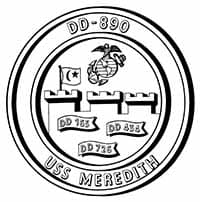
The USS Meredith is the name given to several ships in the United States Navy, most notably USS Meredith (DD-434), a Gleaves-class destroyer commissioned in 1941. During World War II, the USS Meredith played a critical role in escort and patrol duties in the Atlantic and later the Pacific. In October 1942, while supporting the Guadalcanal campaign, Meredith was sunk by Japanese aircraft after a valiant defense, resulting in heavy loss of life. The ship and her crew were honored for their bravery, earning a battle star for World War II service.
USS O'BRIEN
U.S. Navy
HS-15
U.S. Navy
USS FORT MCHENRY
U.S. Navy
MCB 4
U.S. Navy
NAVCAMS WESTPAC
U.S. Navy
NCTC
U.S. Navy
NMCB-7
U.S. Navy
NTTC MERIDIAN MS
U.S. Navy