
Opening branch overview
Building the branch home surface
Loading branch highlights, featured unit context, and gallery moments.
Overview
Members
Units
Building the branch home surface
Loading branch highlights, featured unit context, and gallery moments.
Building the branch units surface
Loading unit filters, rankings, and the branch unit grid.

4 members•1 unit
Relive and share the memories of your service-time with your brothers and sisters in arms today. VetFriends.com can help you reconnect.
Did you proudly serve in the Fleet Information Warfare Center?
Are you looking for someone who is or was in the Fleet Information Warfare Center?
Do you have Fleet Information Warfare Center photos you'd like to share?
Then join a community with your brothers and sisters of the Fleet Information Warfare Center.
Branch
U.S. Navy
Members
4
The Fleet Information Warfare Center (FIWC) was established in August 1995 by the United States Navy to centralize and advance information warfare capabilities in support of fleet operations. Located in Norfolk, Virginia, FIWC’s mission focused on providing expertise in electronic warfare, signals intelligence, information operations, and cyber warfare. The center played a critical role in developing and deploying information warfare tactics, techniques, and technologies to enhance maritime situational awareness and decision-making. In 2005, FIWC was reorganized and its functions were absorbed into the Naval Network Warfare Command (NETWARCOM), further integrating information warfare into the Navy’s operational framework.

Naval Air Station Pensacola Corry Station (NASP Corry Station) • U.S. Navy • 1978
N/A • U.S. Navy

USS Biddle (CG-34) • U.S. Navy • 1991
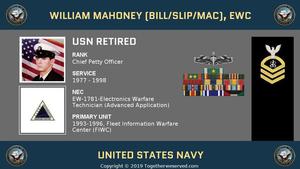
Bill Mahoney • U.S. Navy • 1977