
USN
590,059 members•3,203 units
Opening branch overview
Building the branch home surface
Loading branch highlights, featured unit context, and gallery moments.
Overview
Members
Units
590,059 members•3,203 units
Building the branch home surface
Loading branch highlights, featured unit context, and gallery moments.
Building the branch units surface
Loading unit filters, rankings, and the branch unit grid.
NSGA Winter Harbor Maine
U.S. Navy
Naval Security Group Activity (NSGA) Winter Harbor, Maine, was established in 1935 on the Schoodic Peninsula as a United States Navy radio intercept and direction-finding station. Originally part of the Navy's growing network of signals intelligence (SIGINT) sites, NSGA Winter Harbor played a crucial role during World War II and the Cold War, tracking enemy communications and supporting national security efforts. The facility operated advanced radio and cryptologic equipment, contributing vital intelligence for fleet and national decision-makers. NSGA Winter Harbor was decommissioned in 2002, with its property later transferred to the National Park Service to become part of Acadia National Park.
PATRON-6
U.S. Navy
Patrol Squadron SIX (VP-6), commonly referred to as PATRON-6, was a United States Navy maritime patrol squadron established in July 1943 during World War II. Initially flying the PBY Catalina and later the PB4Y-2 Privateer, the squadron conducted anti-submarine warfare, maritime patrol, and reconnaissance missions in the Pacific Theater. After the war, VP-6 transitioned to the P2V Neptune and participated in the Korean War, where it conducted surveillance and reconnaissance operations. The squadron continued its service through the Cold War, eventually flying the P-3 Orion before being disestablished in 1993.
RVAH-7
U.S. Navy
Reconnaissance Attack (Heavy) Squadron 7 (RVAH-7), known as the "Peacemakers," was a United States Navy squadron established in December 1955. Originally designated as Heavy Attack Squadron 7 (VAH-7), the unit was redesignated RVAH-7 in 1966 when it transitioned from A-3 Skywarrior bombers to the RA-5C Vigilante, a supersonic reconnaissance aircraft. RVAH-7 played a significant role in aerial reconnaissance during the Vietnam War, conducting high-risk missions over North Vietnam from aircraft carriers. The squadron continued to serve throughout the Cold War until it was disestablished in September 1979 as part of the Navy's phase-out of the RA-5C aircraft.
SEAL 2
U.S. Navy
SEAL Team TWO was established in January 1962 as one of the original two Navy SEAL teams, alongside SEAL Team ONE, to meet the growing need for unconventional warfare capabilities during the Cold War. Based at Naval Amphibious Base Little Creek in Virginia, SEAL Team TWO primarily focused on operations in Europe, the Arctic, and the Mediterranean. Throughout its history, the unit has participated in numerous conflicts and special operations, including missions in Vietnam, the Balkans, Iraq, and Afghanistan. Renowned for their maritime expertise and versatility, SEAL Team TWO continues to play a vital role in U.S. Naval Special Warfare operations around the globe.
Specwar
U.S. Navy
Specwar, short for Special Warfare, is a designation commonly used for elite military units specializing in unconventional and high-risk operations. Formed in the late 20th century, Specwar units were established to address the growing need for rapid-response forces capable of counterterrorism, direct action, and reconnaissance missions behind enemy lines. These units are renowned for their rigorous selection process, advanced training in land, sea, and air operations, and proficiency with cutting-edge technology. Over the years, Specwar teams have played pivotal roles in numerous high-profile missions worldwide, earning a reputation for effectiveness, adaptability, and stealth.
US NAVAL STATION MIDWAY ISLAND
U.S. Navy
US Naval Station Midway Island was established in 1941 on Midway Atoll, a strategic outpost in the Pacific Ocean. The station played a pivotal role during World War II, serving as the central base for American forces during the Battle of Midway in June 1942—a turning point in the Pacific War where US forces decisively defeated the Japanese fleet. Throughout the Cold War, the station remained an important refueling and communications hub for the US Navy. The facility was closed as a naval base in 1993, and today Midway Atoll is administered as a wildlife refuge, though its military legacy endures.
USS Ashland (LS- 48)
U.S. Navy
USS Ashland (LSD-48) is a Whidbey Island-class dock landing ship commissioned by the United States Navy in 1992. Named after the historic estate of Henry Clay, the ship has played a vital role in amphibious operations, transporting Marines, vehicles, and landing craft around the globe. Notably, USS Ashland participated in Operation Iraqi Freedom and Operation Enduring Freedom, providing critical support for expeditionary missions. Over its service life, the ship has also been involved in humanitarian assistance and anti-piracy operations, reflecting its versatility and commitment to global maritime security.
USS Barney (DDG-6)
U.S. Navy
USS **Barney (DDG-6)** was a Charles F. Adams-class guided missile destroyer commissioned by the United States Navy in 1962. Throughout her service, Barney participated in key Cold War operations, including patrols in the Mediterranean and support missions during the Vietnam War. The ship conducted NATO exercises, provided naval gunfire support, and took part in surveillance and escort duties. Decommissioned in 1990, USS Barney served nearly three decades before being stricken from the Naval Vessel Register and later scrapped.
USS Beatty (DD-756)
U.S. Navy
USS Beatty (DD-756) was an Allen M. Sumner-class destroyer of the United States Navy, commissioned in March 1945. After serving during the final months of World War II, she participated in occupation duties in the Far East and supported postwar operations in the Pacific. Throughout the Cold War, Beatty operated primarily in the Atlantic and Mediterranean, undertaking NATO exercises, training cruises, and patrolling during the tense early years of the conflict. The destroyer was decommissioned in 1963 and later transferred to Greece, where she served as HS Kanaris (D212).
USS Bowen (DE:FF-1079)
U.S. Navy
USS Bowen (DE/FF-1079) was a Knox-class frigate commissioned by the United States Navy in 1971. Named after Vice Admiral Harold G. Bowen Sr., the ship served primarily in the Atlantic Fleet, performing anti-submarine warfare, escort, and patrol duties during the Cold War era. In 1975, Bowen was reclassified from a destroyer escort (DE) to a frigate (FF), reflecting her evolving mission profile. After over two decades of service, USS Bowen was decommissioned in 1994 and later transferred to the Turkish Navy, where she continued to serve as Akdeniz (F-257).
USS Casimir Pulaski (SSBN-633)
U.S. Navy
USS Casimir Pulaski (SSBN-633) was a James Madison-class fleet ballistic missile submarine commissioned by the United States Navy in 1964. Named after the Polish-American Revolutionary War hero Casimir Pulaski, the submarine played a crucial role in the U.S. nuclear deterrent force during the Cold War. Over its service life, Pulaski completed numerous strategic deterrent patrols, carrying Polaris and later Poseidon ballistic missiles. The vessel was decommissioned in 1994, following the end of the Cold War and subsequent arms reduction treaties.
USS Chosin (CG-65)
U.S. Navy
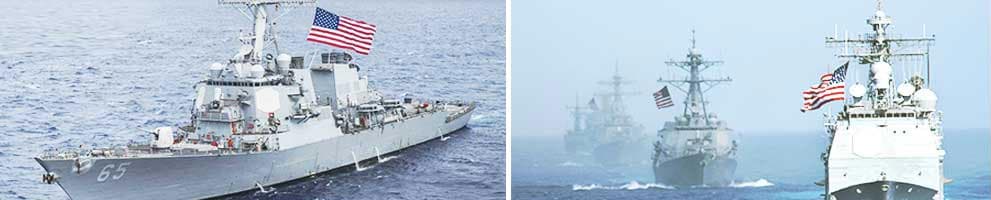
USS Chosin (CG-65) is a Ticonderoga-class guided missile cruiser commissioned into the United States Navy in 1991. Named after the Chosin Reservoir Campaign of the Korean War, the ship has played a significant role in multiple operations, including supporting Operations Southern Watch and Enduring Freedom. Over its service, Chosin has conducted maritime security, air defense, and ballistic missile defense missions, demonstrating the versatility of the Aegis Combat System. The cruiser has also participated in numerous multinational exercises, strengthening alliances and promoting stability in key regions.
USS Clifton Sprague (FFG-16)
U.S. Navy
USS Clifton Sprague (FFG-16) was an Oliver Hazard Perry-class guided-missile frigate of the United States Navy, commissioned on 21 March 1981. Named after Vice Admiral Clifton A.F. Sprague, the ship played a significant role in Cold War naval operations, including anti-submarine warfare and escort missions. Throughout its service, Clifton Sprague participated in several multinational exercises and supported operations in the Atlantic and Mediterranean. The frigate was decommissioned on 2 June 1995 and later transferred to the Turkish Navy, where it served as TCG Gaziantep (F 490).
USS Daniel Webster (SSBN-626)
U.S. Navy
USS Daniel Webster (SSBN-626) was a Lafayette-class ballistic missile submarine commissioned by the United States Navy in April 1964. Named after the renowned American statesman Daniel Webster, the submarine was designed for nuclear deterrence patrols during the Cold War, equipped to launch Polaris and later Poseidon ballistic missiles. Throughout her service, she completed numerous strategic deterrent patrols as part of the U.S. Navy’s fleet of “41 for Freedom” submarines. USS Daniel Webster was decommissioned in August 1990, having played a significant role in maintaining strategic stability during her operational years.
USS Ford (FFG-54)
U.S. Navy
USS Ford (FFG-54) was an Oliver Hazard Perry-class guided missile frigate of the United States Navy, commissioned on 29 June 1985. Named after Gunner's Mate Patrick O. Ford, a Vietnam War hero, the ship was designed for escort missions, anti-air, and anti-submarine warfare. Throughout her service, USS Ford participated in various operations, including drug interdiction patrols in the Caribbean and support missions in the Persian Gulf. After nearly three decades of active duty, the frigate was decommissioned on 31 October 2013.
USS Glover (AGDE-1)
U.S. Navy
USS Glover (AGDE-1), later reclassified as FF-1098, was a unique experimental destroyer escort commissioned by the United States Navy in 1965. Named after Rear Admiral John Glover, the ship was designed to test and evaluate advanced anti-submarine warfare (ASW) systems and tactics during the height of the Cold War. Throughout her service, USS Glover operated primarily with the Atlantic Fleet, participating in numerous trials and exercises to improve the Navy’s ASW capabilities. She was decommissioned in 1990, having contributed significantly to the development of modern naval technology and warfare techniques.
USS Johnston (DD-821)
U.S. Navy
USS Johnston (DD-821) was a Gearing-class destroyer commissioned by the United States Navy in 1946. Named in honor of Lieutenant Commander Ernest E. Evans, hero of the Battle off Samar, the ship served extensively during the Cold War era. Johnston participated in several important operations, including patrol and escort duties in the Atlantic, Mediterranean, and Caribbean, as well as deployments to the 6th Fleet. After decades of active service, she was decommissioned in 1973 and later transferred to the Republic of China Navy, where she served as ROCS Chen Yang (DD-916).
USS Merrimack (AO-179)
U.S. Navy
USS Merrimack (AO-179) was a Cimarron-class fleet oiler of the United States Navy, commissioned on November 7, 1981. Serving primarily in the Atlantic Fleet, she provided vital underway replenishment of fuel and supplies to warships at sea, ensuring sustained naval operations. Merrimack participated in numerous exercises and deployments, including support during operations in the Mediterranean and Persian Gulf. After over two decades of service, she was decommissioned on December 18, 1998, and later struck from the Naval Vessel Register.
USS Reclaimer (ARS-42)
U.S. Navy
The **USS Reclaimer (ARS-42)** was a Bolster-class rescue and salvage ship commissioned by the United States Navy in 1946. She served primarily in the Pacific, supporting fleet operations by conducting salvage, towing, and rescue missions for damaged or stranded vessels. During the Vietnam War, Reclaimer played a crucial role in recovery and repair operations, often working in hazardous combat zones to support naval and allied forces. After decades of distinguished service, she was decommissioned in 1994 and later transferred to the Mexican Navy.
USS Rushmore (LSD 47)
U.S. Navy
USS Rushmore (LSD 47) is a Whidbey Island-class dock landing ship commissioned into the United States Navy on June 1, 1991. Designed to support amphibious operations, Rushmore has participated in numerous deployments, including missions in the Western Pacific, Indian Ocean, and the Arabian Gulf. The ship has supported humanitarian assistance, disaster relief, and combat operations, notably contributing to Operation Iraqi Freedom and Operation Enduring Freedom. With a focus on transporting and launching amphibious craft and vehicles, Rushmore continues to serve as a vital asset for the U.S. Navy’s expeditionary warfare capabilities.
Uss Sides (FFG-14)
U.S. Navy
USS Sides (FFG-14) was an Oliver Hazard Perry-class guided-missile frigate commissioned into the United States Navy in 1981. Named in honor of Admiral John H. Sides, the ship served primarily in the Pacific Fleet, undertaking missions ranging from escort duties to anti-submarine warfare and maritime security operations. USS Sides notably participated in Operation Earnest Will in the late 1980s, escorting reflagged Kuwaiti tankers through the Persian Gulf during the Iran-Iraq War. After nearly two decades of service, the frigate was decommissioned in 2001 and later scrapped.
USS Skipjack (SSN-585)
U.S. Navy
USS Skipjack (SSN-585) was the lead ship of her class and the first nuclear-powered submarine to incorporate the revolutionary teardrop-shaped hull design, which greatly enhanced underwater speed and maneuverability. Commissioned on April 15, 1959, Skipjack set new standards for submarine performance and served as a prototype for future fast-attack submarines of the U.S. Navy. Throughout her career, she participated in numerous Cold War patrols and exercises, demonstrating the effectiveness of nuclear propulsion and modern submarine tactics. After over 30 years of service, USS Skipjack was decommissioned on April 19, 1990.
USS Stark (FFG-31)
U.S. Navy
USS **Stark** (FFG-31) was an Oliver Hazard Perry-class guided-missile frigate commissioned into the United States Navy on October 23, 1982. The ship is most remembered for the tragic incident on May 17, 1987, when it was struck by two Exocet missiles fired by an Iraqi aircraft while patrolling the Persian Gulf, resulting in the deaths of 37 sailors and injuries to 21 others. Despite severe damage, the crew’s heroism and damage control efforts saved the ship from sinking, and USS Stark was able to return to port for repairs. The incident led to changes in U.S. naval procedures and highlighted the risks faced by American forces in volatile regions.
USS Stephen W. Groves (FFG-29)
U.S. Navy
USS Stephen W. Groves (FFG-29) was an Oliver Hazard Perry-class guided-missile frigate of the United States Navy, commissioned on 17 April 1982. Named in honor of Ensign Stephen W. Groves, a naval aviator who was posthumously awarded the Navy Cross for his actions during the Battle of Midway, the ship served in various operations including drug interdiction, maritime security, and multinational exercises. Throughout her service, Stephen W. Groves participated in significant missions such as humanitarian assistance in Haiti and anti-piracy operations off the coast of Africa. After three decades of active duty, the frigate was decommissioned on 24 February 2012.