
USN
589,322 members•3,203 units
Opening branch overview
Building the branch home surface
Loading branch highlights, featured unit context, and gallery moments.
Overview
Members
Units
589,322 members•3,203 units
Building the branch home surface
Loading branch highlights, featured unit context, and gallery moments.
Building the branch members surface
Loading branch members, era browse tools, and directory controls.
USS Howard W. Gilmore (AS-16)
U.S. Navy
USS Howard W. Gilmore (AS-16) was a Fulton-class submarine tender commissioned by the United States Navy in 1944. Named after Medal of Honor recipient Commander Howard W. Gilmore, the ship provided vital repair, supply, and logistical support to submarines operating in the Pacific Theater during World War II. After the war, the Gilmore continued servicing submarines during the Cold War era, including deployments to the Atlantic and Mediterranean fleets. Decommissioned in 1980, the vessel played a crucial role in maintaining the operational readiness of the U.S. submarine force for over three decades.
VA-176
U.S. Navy
Attack Squadron 176 (VA-176), also known as the "Thunderbolts," was a United States Navy attack squadron established on 1 May 1955. The squadron gained distinction during the Vietnam War, notably on 19 October 1966, when one of its A-1 Skyraider pilots, LTJG William T. Patton, shot down a North Vietnamese MiG-17 with Zuni rockets—one of the few piston-engine victories against a jet in history. VA-176 operated from carriers such as USS Intrepid (CVS-11) and participated in numerous combat operations and support missions. The squadron was disestablished on 1 February 1972, after nearly 17 years of service.
Combat Systems Technical Schools Command - Mare Island
U.S. Navy
The Combat Systems Technical Schools Command at Mare Island was a pivotal United States Navy training facility established during the Cold War era. Located at Mare Island Naval Shipyard in Vallejo, California, the command specialized in advanced technical training for sailors in combat systems, including electronics, weapons, and fire control. Its graduates played crucial roles in the operation and maintenance of sophisticated naval technologies aboard U.S. warships. The school supported fleet readiness until the base's closure in the mid-1990s, after which its mission was transferred to other Navy training centers.
USS Bennington (CV-20)
U.S. Navy
USS Bennington (CV-20) was an Essex-class aircraft carrier commissioned by the United States Navy in August 1944. She played a significant role in the Pacific Theater during World War II, participating in major operations such as the Battle of Okinawa and air strikes against the Japanese home islands. After the war, Bennington was decommissioned, but later modernized and recommissioned for service during the Korean War and the Cold War, including anti-submarine warfare duties. The ship was finally decommissioned in 1970, earning numerous battle stars for her distinguished service.
USS FOX CG-33
U.S. Navy
USS Fox (CG-33) was a Belknap-class guided missile cruiser commissioned by the United States Navy on May 28, 1966. Originally designated DLG-33 (guided missile frigate), she was reclassified as a cruiser in 1975. Throughout her service, Fox operated extensively in the Pacific and Indian Oceans, including multiple deployments to the Vietnam War, where she provided naval gunfire support and served as a radar picket ship. The ship also played a role in Cold War operations, conducting surveillance and exercises with allied navies until her decommissioning on April 15, 1994.
USS Vancouver
U.S. Navy
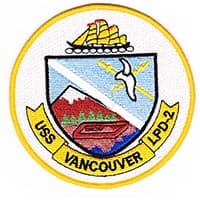
USS Vancouver (LPD-2) was an Austin-class amphibious transport dock commissioned by the United States Navy in 1963. During the Vietnam War, she played a vital role in amphibious operations, troop transport, and support missions, participating in multiple campaigns and earning several battle stars. Throughout the 1970s and 1980s, USS Vancouver continued to serve in the Pacific, taking part in exercises, humanitarian missions, and deployments that reinforced U.S. presence in the region. She was decommissioned in 1992, having served nearly three decades as a key asset in the Navy's amphibious fleet.
CVN-72
U.S. Navy
USS Abraham Lincoln (CVN-72) is a Nimitz-class nuclear-powered aircraft carrier commissioned into the United States Navy in November 1989. Throughout its service, the ship has participated in major operations, including Operation Desert Storm in 1991 and Operation Iraqi Freedom in 2003, providing critical air support and power projection. The carrier has undergone several deployments to the Western Pacific, Indian Ocean, and Persian Gulf, showcasing American naval presence and deterrence. After a four-year Refueling and Complex Overhaul (RCOH) completed in 2019, USS Abraham Lincoln remains an integral part of U.S. naval operations worldwide.
NAS Quonset Point, RI
U.S. Navy
Naval Air Station (NAS) Quonset Point, located in North Kingstown, Rhode Island, was commissioned in 1941 as a key naval aviation facility during World War II. Throughout the war, it served as a major training and operational base for carrier aircraft, anti-submarine patrols, and the assembly and repair of aircraft. NAS Quonset Point remained active during the Cold War, supporting fleet air operations and housing various squadrons, including those flying the S-2 Tracker and E-1 Tracer. The base was decommissioned in 1974, but its legacy continues through the Quonset Air Museum and the Rhode Island Air National Guard, which still operates at the site.
Naval Hospital Yokosuka
U.S. Navy
Naval Hospital Yokosuka was established in 1950 to serve the United States Navy and allied forces in the Western Pacific region. Located at Fleet Activities Yokosuka, Japan, it played a critical role in providing medical care during the Korean and Vietnam Wars, treating both combat casualties and military families. Over the decades, the hospital expanded its capabilities, supporting humanitarian missions and joint exercises with Japanese and allied forces. Today, Naval Hospital Yokosuka remains a key medical facility for U.S. forces in the Indo-Pacific, offering advanced healthcare and supporting regional security and readiness.
U.S. Navy (2026 - 2026)
U.S. Navy Veteran (2026 - Present)
U.S. Navy Active Duty (2025 - Present)
U.S. Navy Parent (2025 - Present)