
USN
589,298 members•3,203 units
Opening branch overview
Building the branch home surface
Loading branch highlights, featured unit context, and gallery moments.
Overview
Members
Units
589,298 members•3,203 units
Building the branch home surface
Loading branch highlights, featured unit context, and gallery moments.
Building the branch members surface
Loading branch members, era browse tools, and directory controls.
NAS Chase Field
U.S. Navy
Naval Air Station (NAS) Chase Field was established in 1943 near Beeville, Texas, as a pilot training facility during World War II. Originally designed to support the U.S. Navy’s need for more aviators, Chase Field played a key role in training naval aviators during the war and continued its mission through the Korean and Vietnam War eras. The base specialized in advanced jet training, notably hosting Training Air Wing Three and serving as a home for various training squadrons. NAS Chase Field remained a critical part of naval aviation training until its closure in 1993 as part of the Base Realignment and Closure (BRAC) process.
SIMA (PEARL HARBOR)
U.S. Navy
Shore Intermediate Maintenance Activity (SIMA) Pearl Harbor was established to provide essential maintenance and repair support to the United States Navy fleet stationed at Pearl Harbor, Hawaii. Throughout its operational history, SIMA Pearl Harbor played a crucial role in ensuring the operational readiness of surface ships through intermediate-level repairs, upgrades, and logistical support. The unit supported naval operations during critical periods, including the Cold War and post-Cold War eras, adapting to evolving technological and strategic demands. In the early 2000s, SIMA Pearl Harbor was reorganized as part of broader Navy maintenance restructuring, eventually merging into the Regional Maintenance Center system to enhance efficiency and fleet support.
USS Hancock (CV-19)
U.S. Navy
USS Hancock (CV-19) was an Essex-class aircraft carrier commissioned by the United States Navy in April 1944. She served with distinction in the Pacific Theater during World War II, participating in major operations including the Battle of Leyte Gulf and supporting air strikes against Japanese positions across the Pacific. After the war, Hancock was modernized and played a vital role during the Korean and Vietnam Wars, providing air support and conducting combat missions. The carrier was eventually decommissioned in 1976, leaving behind a legacy of valor and service across three decades of American naval history.
_insignia%2C_1953.png&w=3840&q=75)
USS HORNET
U.S. Navy
USS Hornet is the name carried by several distinguished ships in U.S. Navy history, most famously the aircraft carrier CV-8. Commissioned in 1941, USS Hornet (CV-8) played a pivotal role in World War II, notably launching the Doolittle Raid on Tokyo in April 1942, the first air raid to strike the Japanese home islands. The carrier also participated in the pivotal Battle of Midway, contributing to the turning of the tide in the Pacific Theater. Despite her heroic service, CV-8 was sunk during the Battle of the Santa Cruz Islands in October 1942, but her legacy endures through subsequent ships bearing the Hornet name, including CV-12, which served in World War II and later as a recovery ship for Apollo missions.
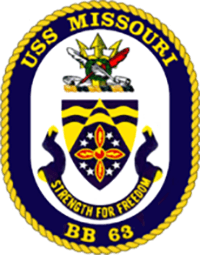
USS MISSOURI
U.S. Navy
The USS Missouri (BB-63), an Iowa-class battleship, was commissioned into the United States Navy on June 11, 1944. She played a significant role in World War II, providing fire support during the battles of Iwo Jima and Okinawa, and famously served as the site of Japan’s formal surrender on September 2, 1945, ending the war. The "Mighty Mo" later saw action during the Korean War, delivering naval gunfire in support of UN forces. After being decommissioned and reactivated, she participated in Operation Desert Storm in 1991 before her final decommissioning in 1992.
USS Peleliu (LHA 5)
U.S. Navy
USS Peleliu (LHA 5) was a Tarawa-class amphibious assault ship commissioned into the United States Navy on May 3, 1980. Named after the Battle of Peleliu in World War II, the ship served as a flagship for amphibious ready groups, supporting Marine Corps operations and humanitarian missions worldwide. Notably, USS Peleliu participated in Operation Desert Storm, Operation Enduring Freedom, and disaster relief efforts such as Operation Unified Assistance after the 2004 Indian Ocean tsunami. After more than 34 years of distinguished service, USS Peleliu was decommissioned on March 31, 2015.
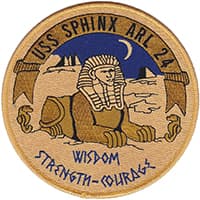
USS Sphinx
U.S. Navy
USS Sphinx (ARL-24) was a landing craft repair ship of the United States Navy, originally commissioned in 1945 near the end of World War II. Built as LST-963 and later converted to an Achelous-class repair ship, she provided crucial repair and maintenance services to amphibious forces in the Pacific. Reactivated for the Vietnam War, USS Sphinx supported riverine and coastal operations, earning multiple campaign stars for her service. Decommissioned in 1971, she continued to serve in civilian roles before being struck from the Naval Vessel Register.
AR-8
U.S. Navy
**AR-8 Military Unit History:** The AR-8 is a fictional or unspecified designation, as there is no widely recognized or historically documented military unit under this title in major global armed forces. If you are referring to a specific army, navy, or air force unit with this code, please provide more context or clarification. However, in a generic sense, AR-8 could refer to a specialized reconnaissance or armored regiment formed during a mid-20th-century conflict, tasked with rapid deployment and intelligence gathering. Units with similar designations typically played crucial roles in advancing frontlines and providing critical battlefield information, often participating in key operations and earning commendations for their effectiveness and bravery. If you need a detailed history for a real or more specific unit, please provide additional details.
SIMA, San Diego
U.S. Navy
SIMA San Diego (Shore Intermediate Maintenance Activity, San Diego) was established to provide maintenance and repair support for the U.S. Navy's surface fleet stationed in the San Diego area. Originally formed during the Cold War era, SIMA San Diego played a critical role in ensuring the operational readiness of ships by offering a wide range of technical services, from hull repairs to electronic systems maintenance. The unit worked closely with fleet units and shipyards, adapting to evolving naval technologies and operational demands. In the early 2000s, as part of Navy restructuring, SIMA San Diego was reorganized and its functions integrated into the Regional Maintenance Center (RMC) system to further streamline fleet support operations.
U.S. Navy (2026 - 2026)
U.S. Navy Veteran (2026 - Present)
U.S. Navy Active Duty (2025 - Present)
U.S. Navy Parent (2025 - Present)